2. Spherical Harmonics
2.1. Geoid Height
The Level-2 spherical harmonic product of GRACE and GRACE-FO provides monthly estimates of the Earth’s gravitational field [see Low-Degree Harmonics]. The Earth’s gravitational field varies in time as masses on and within the Earth move and are exchanged between components of the Earth system [78]. The instantaneous shape of the Earth’s gravitational field can be described in terms of an equipotential surface, a surface of constant potential energy where the gravitational potential is constant [27]. The Earth’s geoid is the equipotential surface that coincides with global mean sea level if the oceans were at rest [27, 78]. The distance between the geoid and an Earth reference ellipsoid is the geoid height (\(N\)), or the geoidal undulation [27].

Figure 2.1: Relationship between ellipsoid height, geoid height, and topographic height [89]
In spherical coordinates, the change in the height of the geoid, \(\Delta N(\theta,\phi)\), at colatitude \(\theta\) and longitude \(\phi\), can be estimated from a series of spherical harmonics as:
where \(a\) is the average radius of the Earth, \(P_{lm}(\cos\theta)\) are the fully-normalized Legendre polynomials of degree \(l\) and order \(m\) for the cosine of colatitude \(\theta\), and \(\Delta C_{lm}\), \(\Delta S_{lm}\) are the changes in the cosine and sine spherical harmonics of degree \(l\) and order \(m\) [8].
2.2. Surface Mass Density
The radial component of a density change within the Earth cannot be uniquely determined using satellite gravity observations alone [78]. However, fluctuations in water storage and transport can be assumed to be largely concentrated within a thin layer near the Earth’s surface [78]. With this assumption, the Earth’s surface mass density (\(\Delta\sigma(\theta,\phi)\)), the integral of the density change (\(\Delta\rho(r,\theta,\phi)\)) through the thin surface layer, can be estimated as the following:
where \(\rho_{ave}\) is the average density of the Earth, and \(k_l\) is the gravitational potential load Love number of degree \(l\). Using this assumption, solid Earth variations occurring outside of this thin layer, such as Glacial Isostatic Adjustment (GIA) effects, must be independently estimated and removed.
2.3. Low-Degree Harmonics
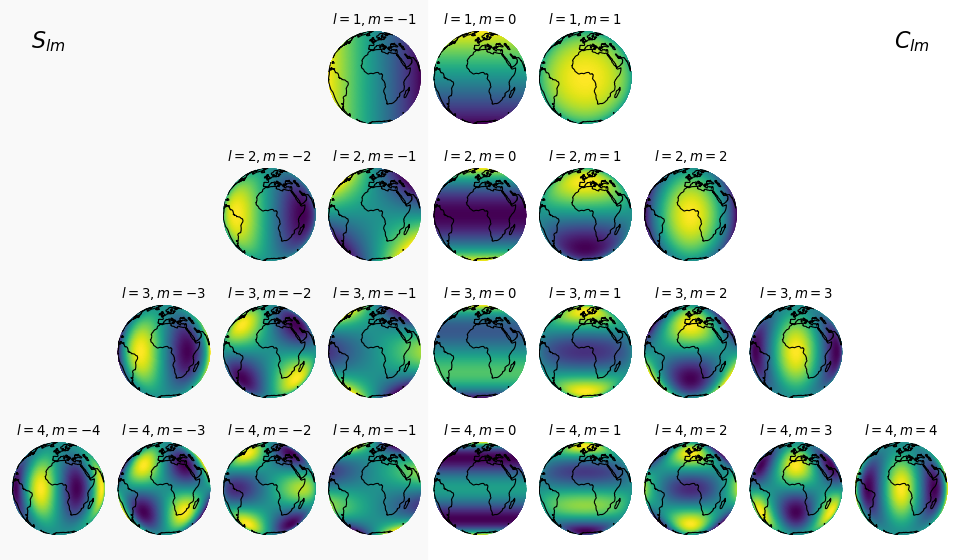
Figure 2.2: Spherical harmonics for degrees 1 through 4